
In vitro model of the Blood Brain Barrier (BBB)
Analyzing if and how molecules cross the blood brain barrier is fundamental to understanding neurological disease and the mechanisms of drug action.
At IRBM we have developed a relevant and robust in vitro BBB model using brain microvascular endothelial cells (BMECs). We use BMECs derived from human induced pluripotent stem cells (iBMECs) to generate BBB models that exhibit physiological barrier functions, such as high trans-endothelial electrical resistance (TEER) and expression of transporter proteins.
In our transwell system, iBMECs are seeded on the apical side and astrocytes are seeded on the underside of the insert. The system forms complex tight junctions with functional BBB markers (SLCs, ABC transporters and receptors).
Overall, the model provides a reliable and reproducible in vitro test for CNS penetration, whether it’s a small molecule, peptide, or antibody.
Transwell configuration
- iBMEC
- Astrocytes
- Tight junctions
Advantages
- Mimic several in vivo conditions (TEER ~ 5000 Ω·cm2 complex tight junctions, functional SLCs, ABC transporters and receptors)
- Reproducible and scalable for medium throughput
- Cost-effective
- Custom experimental approaches and ad hoc studies
- It has proven to offer valuable insights into BBB permeability of different drug modalities and drug delivery strategies (small molecules, peptides, antibodies and nanoparticles)*
Four questions the same barrier answers
Permeability
How much crosses, and how fast
Bidirectional measurement returns an apparent permeability and a mass balance, with integrity markers on every plate. The tight junctions keep the paracellular route closed, so what you measure is the molecule, not a leak.
Propranolol, passive diffusion · 22.0 ×10⁻⁶ cm/s
Lucifer Yellow, paracellular · 0.33 ×10⁻⁶ cm/s
Transcellular vs paracellular route
Efflux
Whether the barrier pumps it back out
ABCB1 (P-gp) and ABCG2 (BCRP) are functional in the model. Polarised efflux appears as a directional ratio between apical-to-basal and basal-to-apical transport, so a low number comes with an explanation rather than without one.
ABCB1 (P-gp) · ABCG2 (BCRP) · efflux ratio from bidirectional transport
Polarised efflux at the apical membrane
Influx
Whether a carrier takes it in
Major Solute Carrier Transporters (SLCs) such as SLC7A5 (LAT1), SLC2A1 (GLUT-1), and other solute carriers are active in the model, so carrier-directed designs can be tested directly rather than inferred. Influx and efflux are measured in the same system, on the same monolayer.
SLC7A5 (LAT1) and further solute carriers · functional
Carrier-mediated influx
Transcytosis
The route for large molecules: application of the model to brain targeted biologics
The human BBB model discriminates transcytosis of anti-TfR antibodies from control antibody.
A shuttle either works or it does not, and the assay says which before an in vivo study is designed around it.
RECEPTOR-MEDIATED TRANSCYTOSIS (TfR)
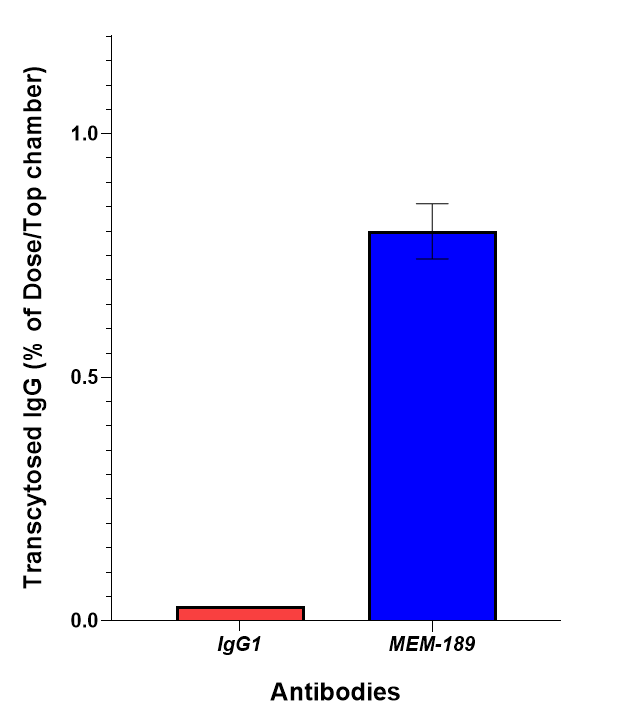 TRANSCYTOSED IgG · MEM-189 VS CONTROL IgG1
It tracks the human number
The model demonstrates good correlation between BBB permeability and human Kpuu values for known drugs.
It also separates formulations, not only molecules: free and liposome-encapsulated kynurenic acid give different permeability in the same system, so a delivery strategy can be tested before it reaches an in vivo study.
The model was established and published with CHDI Foundation, then applied to candidate selection for Huntington’s disease.
In vitro permeability in the iBMEC model against in vivo human Log Kpuu,CSF. Trend line fitted across all compounds shown. Di Marco A. et al., Int. J. Mol. Sci. 2022.
Confirmed in vivo
An in vitro number is a prediction, and predictions get confirmed. Brain and plasma distribution, Kpuu determination and CNS bioanalysis run at the same research site, through a single coordinated team.
Continue on
Start here
One compound set, through one tier
A permeability screen on ten compounds tells you whether you have a CNS series at all. Efflux and influx explain the results you did not expect, and transcytosis opens the biologics route.
When the program needs the rest, the assay sits inside an integrated program to preclinical candidate.
Frequently asked questions
What kind of blood brain barrier model does IRBM use?
A human in vitro model built from brain microvascular endothelial cells derived from induced pluripotent stem cells (iBMECs), grown in a transwell with astrocytes on the underside of the insert. It forms complex tight junctions, reaches a TEER of approximately 5,000 Ω·cm2, and carries functional SLCs, ABC transporters and receptors.
Can the model test antibodies and peptides, or only small molecules?
All three. Small molecules, peptides and antibodies run in the same system. For large molecules the relevant route is receptor-mediated transcytosis, which is established in the model for the transferrin receptor.
How predictive is it of human brain penetration?
Across CNS drugs, in vitro permeability correlates with in vivo human Log Kpuu,CSF at R2 = 0.7. The model has also been cross-checked against a primary porcine brain endothelial system, giving comparable permeability for proprietary CNS compounds.
Can efflux and influx transporters be assessed separately?
Yes. ABCB1 (P-gp) and ABCG2 (BCRP) efflux is measured as a directional ratio from bidirectional transport. SLC7A5 (LAT1) and other solute carriers are functional, so carrier-mediated influx can be tested directly on the same monolayer.
How is a study run, and where?
Studies run in 12-transwell format on 1.2 cm2 inserts, bidirectionally, from minutes to two or three days. A 24-transwell format can also be used for higher throughput. Every plate carries TEER and integrity markers subjected to paracellular transport (Lucifer Yellow, sucrose, mannitol). Analysis is by LC-MS, immunoassay, radiometric or fluorescent readout, and results are returned as permeability, mass balance, intracellular distribution and toxicity. All work is carried out at IRBM’s single research site in Rome, Italy.
Start a conversation.
Great science begins here.