
The real cost of the wrong partner is time
Choosing a discovery partner is a strategic decision, not a procurement one. The wrong one can cost 12 to 18 months. That time is rarely lost at the bench: it is lost on a target that was never properly validated, on a hit series that could not be developed, or on a lead that failed on properties nobody measured early enough.
Integration compresses that loss in one specific way. The scientists who run the next experiment are already on the program, so a result becomes a decision within days.
A selection of projects we have delivered to our partners
Across different modalities and therapeutic areas.
One program, from a screen to oral efficacy
IRBM chose this target and ran the campaign with public grant support. It shows what the sequence looks like when nothing changes hands.
From a 121K small molecule phenotypic screen to a structure-guided, orally bioavailable NS2B-NS3 protease inhibitor with a novel allosteric mechanism, with activity across related flaviviruses (Dengue, West Nile).
121,000 compounds from the IRBM collection tested against a ZIKV replicon in a phenotypic cell-based assay. Eight hits survived confirmation.
Resistant clones carried a single point mutation in NS3.
NS2B-NS3 protease identified as the target.
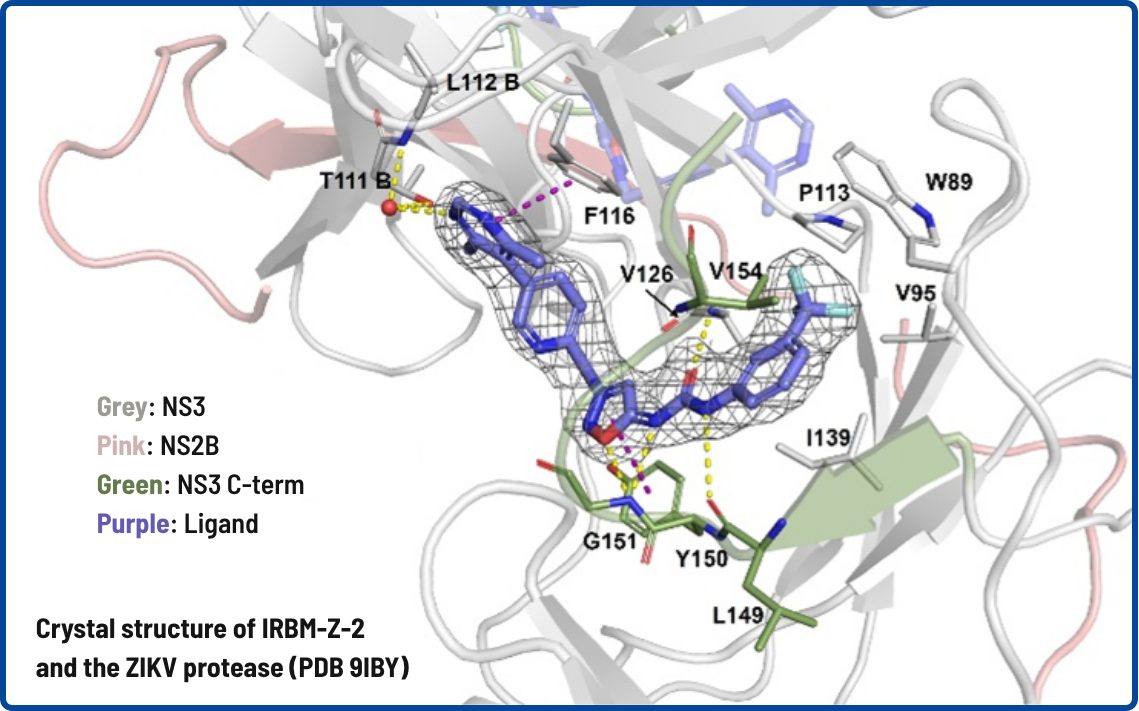
A crystal structure was obtained, revealing the compound bound to an allosteric pocket distinct from the active site and stabilizing the protease in an inactive open conformation.
Structure-guided optimization transformed the series. Potency improved from 6 µM for IRBM-Z-1 in the replicon assay to 20 nM for IRBM-Z-2, a 300-fold increase, while oral bioavailability in mice reached 90%.
Twice-daily oral dosing in infected mice left viral loads more than six orders of magnitude below untreated controls, with complete survival over 14 days.
The work was published in Nature Communications in 2026.
All achieved at the same research site. More details on Infectious Disease.
Programs start at the stage that needs answering
An integrated program can begin at any stage. Partners commonly start with one capability, then scale by milestone as the data supports it. Flexible in scope, never fragmented in team.
Where a program needs a method that does not yet exist, it is developed. Assays and models are built specifically for the target or built for purpose.
One project representative manages the program throughout, with scientific reporting on an agreed schedule and the underlying data returned in your preferred format.
Move faster from target to preclinical candidate
IRBM’s Integrated Drug Discovery platform unites chemistry, biology, DMPK, and in vivo pharmacology under one scientific framework so candidates advance through fewer handoffs, stronger data continuity, and better-informed decisions.
Frequently Asked Questions
Can I engage one capability without running a full integrated program?
Yes. Every capability at IRBM runs as a standalone engagement, and many partners start that way. A single assay, a screening campaign or a chemistry package can be scoped on its own. When a program requires more than one capability, the same team carries it and the series does not change hands.
What does an integrated program deliver?
The deliverable is agreed at the start from target validation, hit identification, hit to lead, lead optimization or preclinical candidate. The data package supporting that stage is returned in full.
How is the program managed, and what reporting do I receive?
One project manager is your point of contact throughout, with scientists always available. Scientific reporting runs on a schedule agreed at the start, with the underlying data returned alongside it. Go/no-go criteria are set before the chemistry begins, so a series that cannot reach the desired profile is stopped to ensure timely and cost effective decisions.
Which modalities do you run integrated programs on?
Small molecules, peptides and antibodies, including macrocyclic peptides, peptide conjugates and antibody-drug conjugates. Target class decides modality, and that decision is made before chemistry commits. All three are established at the same research site.
Start a conversation.
Great science begins here.