


Speziale, R., Iacovelli, V., Leoni, G., et al. (2026). Biology Direct, a Springer Nature journal. https://doi.org/10.1186/s13062-026-00766-8
Non-Muscle Invasive Bladder Cancer (NMIBC) and the Challenge of Long-Term Surveillance
Non-muscle-invasive bladder cancer (NMIBC) represents around 75% of newly diagnosed bladder cancer cases. Although prognosis at diagnosis is often favorable, recurrence rates remain high, requiring long-term cystoscopic surveillance.
This repeated invasive monitoring can be burdensome for patients and contributes significantly to healthcare costs and resource use.
Current urine-based biomarkers often show limited reproducibility because they are influenced by hydration status, inflammation, and other pre-analytical variables. As a result, there is growing interest in more robust and non-invasive alternatives.
Plasma metabolomics offers a promising complementary approach, combining greater analytical stability with the ability to capture systemic metabolic changes associated with tumor biology.
Plasma Metabolomics for NMIBC Detection
Developed through a translational collaboration between IRBM and the clinical team at San Carlo di Nancy Hospital, coordinated by Prof. Bove, a new study published in Biology Direct (Springer Nature) shows that targeted plasma metabolomics can identify a metabolic signature associated with non-muscle-invasive bladder cancer (NMIBC), including in patients without hematuria, its most common presenting symptom.
These findings support the development of plasma-based biomarkers able to capture systemic tumor-related changes and complement current surveillance approaches.
Study Design: Targeted Plasma Metabolomics at IRBM
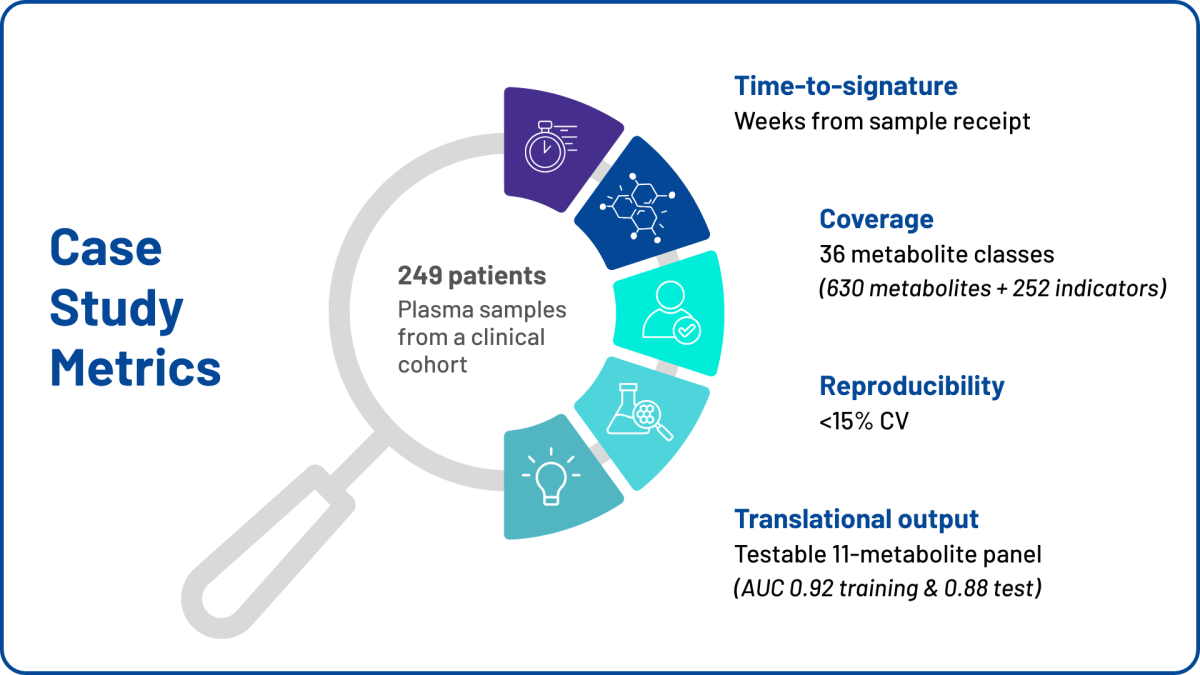
Targeted metabolomic profiling was performed at IRBM using the Biocrates MxP® Quant 500 kit, quantifying 630 metabolites and 252 metabolic indicators in plasma samples from 249 individuals, including 51 NMIBC patients and 198 healthy controls.
The cohort was supported by structured clinical metadata, including age, BMI, smoking status, comorbidities, and hematuria status. Integrated bioinformatic analyses were applied to explore clinically relevant correlations, compare patient subgroups, and place metabolic alterations within a broader biological context.
Key Findings: The NMIBC Plasma Signature
Statistical analyses identified:
- 29 significantly altered metabolites and 17 metabolic indicators
- Reduced conjugated bile acids (GCDCA, GDCA, TDCA, GCA)
- Increased lysophosphatidylcholines and polyunsaturated fatty acids (PUFAs)
- Pathway perturbations involving bile acid biosynthesis, PUFA metabolism, glutathione metabolism, and glycolysis
Although hematuria was significantly associated with NMIBC diagnosis (Chi-square test, p<0.0001), plasma metabolic profiles were not primarily driven by hematuria status, an important finding for patients who present without this common symptom.
An 11-metabolite generalized linear model achieved strong diagnostic performance, with an AUC of 0.92 in the training set and 0.88 in the hematuria-negative test set.
Translational Next Steps
This study should be regarded as a discovery-phase pilot, providing an initial basis for the development of plasma-based biomarkers in NMIBC. The identified metabolomic signature and the associated predictive model remain exploratory and require confirmation in larger, independent, and longitudinal cohorts before any clinical application can be considered.
Further work will be needed to better address clinical heterogeneity, refine patient stratification, and assess reproducibility over time. Importantly, this study may also help open new opportunities for clinical collaboration and support the investment needed to advance prospective and longitudinal biomarker development programs.