
Torrente, E., Quotadamo, A., Corio, A, et al. (2026). Journal of Medicinal Chemistry. https://doi.org/10.1021/acs.jmedchem.6c00476
From Hit to Lead: The Chemistry Story Behind IRBM-Z-2
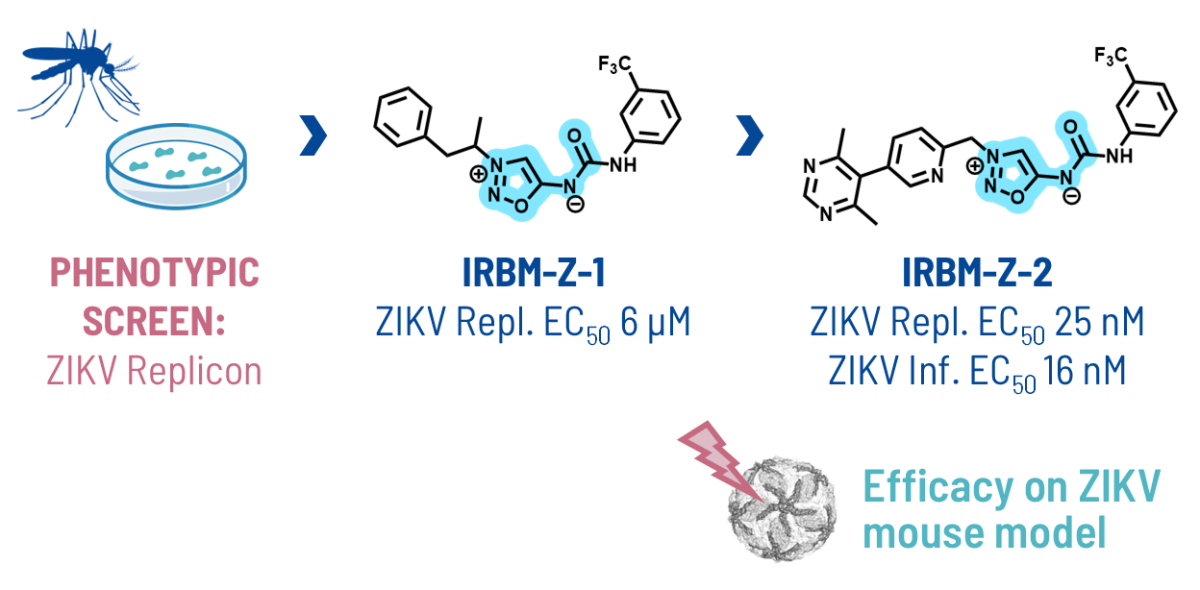
Every successful drug candidate begins with a hit compound and a question: can we make it better? For IRBM’s Zika virus antiviral program, that question drove an extensive optimization campaign resulting in IRBM-Z-2: a nanomolar, orally bioavailable inhibitor of the Zika virus NS2B-NS3 serine protease with demonstrated in vivo efficacy.
This paper, published in the Journal of Medicinal Chemistry, details the full hit-to-lead journey: the structure-activity relationships that shaped the compound series, the structural biology that informed each design cycle, and the ADME work that translated potency into a viable preclinical profile.
It follows the team’s earlier Nature Communications publication (DOI: 10.1038/s41467-026-68943-x), which reported the allosteric mechanism and the first demonstration of oral efficacy in mouse models.
Together, the two papers provide a complete picture of the program.
Why the Zika Virus NS2B-NS3 Protease Is a Compelling Antiviral Target
Zika virus remains an unmet medical need, and no approved antivirals or vaccines exist. The NS2B-NS3 protease is essential for viral replication, making it a well-validated target. Yet most reported competitive inhibitors suffer from poor cell permeability or insufficient cellular potency, limiting their translational potential.
IRBM’s phenotypic screening approach identified a hit compound without prior knowledge of its target. Subsequent resistance generation and target deconvolution revealed that the series acts on the NS2B-NS3 protease — and, critically, that it does so through a previously undescribed allosteric pocket that locks the enzyme in a catalytically inactive conformation. This non-competitive mechanism, uncovered through a combination of biochemical, biophysical, and structural studies, bypasses the permeability and potency limitations that have historically constrained orthosteric NS3 inhibitors.
A Chemically Unusual Scaffold With a Unique Binding Mode
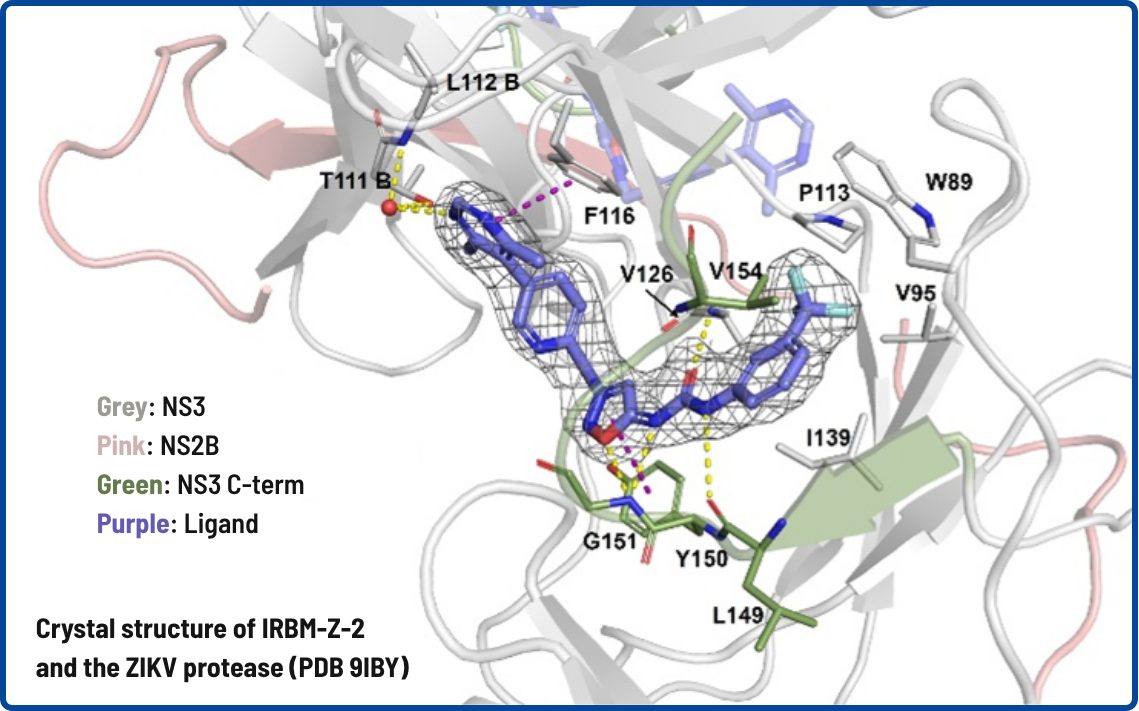
Optimization of this exotic N-carbamoylsydnone imine series revealed that its allosteric hydrogen-bond network is essentially irreplaceable. Potency gains were achieved by extending the solvent-exposed region with a biaryl extension, enableing a π-stacking interaction with residue F116. This binding mode, predicted via docking, was structurally confirmed by X-ray crystallography.
From Potency to Preclinical Profile
Parallel ADME optimization successfully resolved early aqueous solubility liabilities. Strategic ortho-substitution on the biaryl LHS region improved kinetic solubility to 174 µM while preserving cellular potency. The final lead, IRBM-Z-2, achieved 90% oral bioavailability in mice, low intrinsic clearance across species, good passive permeability, and a clean CYP/hERG profile, supporting a twice-daily oral dosing regimen.
In a ZIKV mouse model, oral IRBM-Z-2 demonstrated robust in vivo efficacy:
- Viral clearance: serum viral RNA was reduced by 6 log₁₀ by day three, falling below the limit of detection by day five.
- Survival benefit: complete survival through day 14 was observed in all treated animals, versus vehicle controls which reached humane endpoints. Meaningful antiviral activity was retained even when treatment was delayed up to 48 hours post-infection.
- Broad-spectrum activity: beyond ZIKV, IRBM-Z-2 inhibits the NS3 proteases of Dengue virus serotype 2 and West Nile virus, establishing a basis for broader pan-orthoflavivirus optimization.
Integrated Drug Discovery: From Phenotypic Screen to Preclinical Candidate
This program exemplifies highly integrated drug discovery, driven by the close coordination of medicinal chemistry, structural biology, computational chemistry, DMPK and infectious disease biology.
Through iterative design cycles — in which docking predictions were experimentally validated via co-crystal structures at key optimization stages, and real-time ADME data fed directly into the next round of synthesis — the team compressed the hit-to-lead timeline. The result is a preclinical candidate with a well-grounded mechanism and a thoroughly characterized structure-property profile.
For pharma and biotech partners working on flavivirus programs or broader antiviral strategies, this body of work demonstrates both a validated allosteric mechanism and a tractable chemical series with room for further optimization.
Key Takeaways
- IRBM identified a novel allosteric pocket in the ZIKV NS2B-NS3 protease and developed a potent inhibitor series based on the N-carbamoylsydnone imine chemotype
- Systematic SAR and structure-based design across three scaffold regions delivered IRBM-Z-2: a nanomolar ZIKV inhibitor with 90% oral bioavailability and a clean preclinical ADME/safety profile
- Three co-crystal structures document the binding mode and provide a structural basis for continued optimization
- In the lethal AG129 mouse model, oral administration of IRBM-Z-2 achieved complete survival and viral clearance. Notably, robust antiviral efficacy was maintained even when treatment was delayed until 48 hours post-infection
- Activity extends to DENV2 and WNV proteases, supporting a pan-orthoflavivirus strategy