
Ciammaichella, A., et al. (2026). Journal of Medicinal Chemistry. https://doi.org/10.1021/acs.jmedchem.6c01182
Targeted therapies for RAS-driven cancers can deliver strong initial responses, but tumors often develop adaptive resistance. SHP2-mediated feedback reactivates the MAPK pathway, undermining treatment response and driving disease recurrence.
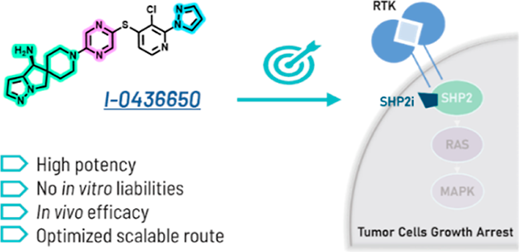
I-0436650 emerged as a potent, selective, and orally bioavailable allosteric SHP2 inhibitor. The compound demonstrated to suppress tumor growth as a monotherapy in xenograft models and delayed tumor relapses when used in combination with EGFR-RAS-MAPK pathway-targeted agents, including osimertinib and adagrasib, supporting its advancement as a preclinical candidate for further development.
This publication describes the medicinal chemistry efforts that led to I-0436650 and the extensive in vivo characterization behind it.
SHP2 as a Therapeutic Target in RAS-Driven Cancers
SHP2 (Src Homology Region 2 protein tyrosine phosphatase) acts as a molecular hub that regulates the MAPK pathway and other growth-related signals inside the cell. These characteristics make it a promising target for inhibiting cancer progression across a wide range of tumor types, including those driven by KRAS and EGFR mutations.
SHP2 is not only involved in driving tumor growth but also contributes to therapeutic resistance. Even when therapies targeting EGFR or KRAS initially work, cancer cells can reactivate the same growth signals, reducing the long-term effectiveness of treatment. Because of this dual role, both promoting cancer and enabling drug resistance, SHP2 has become a promising target in oncology. Several SHP2 inhibitors are currently under clinical investigation, primarily in combination with other targeted agents, since their antitumor activity as single agents has been limited; however, no SHP2 inhibitor has yet been approved by the FDA.
The Discovery of I-0436650
The discovery of I-0436650 is the result of medicinal chemistry optimization executed at IRBM. Through the design and evaluation of multiple chemical series, researchers progressively overcame key challenges to finally identify a compound with an attractive preclinical profile.
The study also reports the co-crystal structure of I-0436650 bound to SHP2, providing structural confirmation of its mechanism of action.
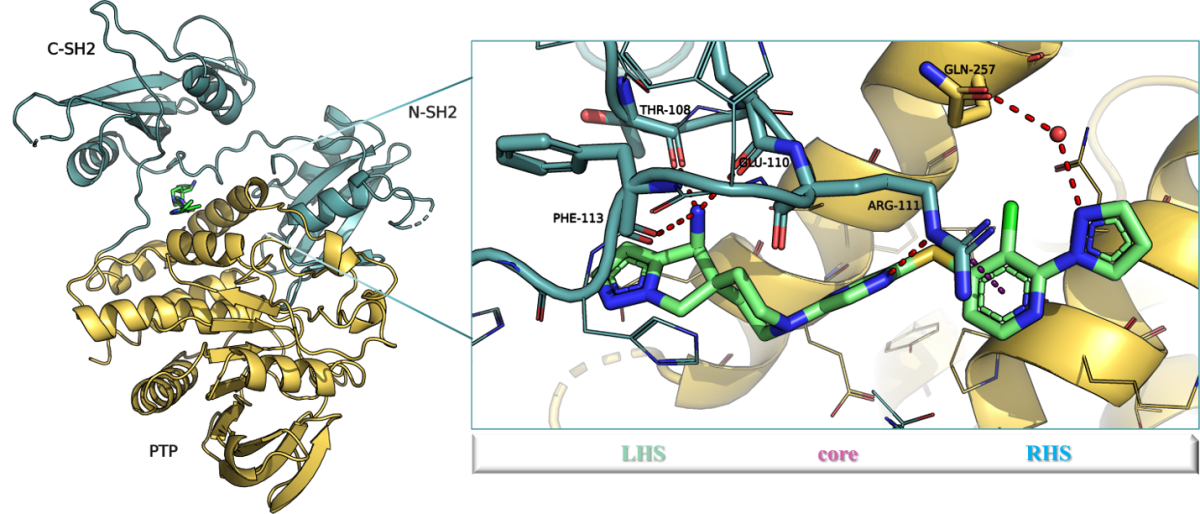
Overall structure of hSHP2 containing ligand I-0436650 (PDB: 29MM)
Profile of I-0436650
- Potency. Active both in enzymatic and cellular assays (hSHP2-wt IC₅₀ 4 nM, pERK IC₅₀ = 13 nM, antiproliferation IC₅₀ = 216 nM).
- Selectivity. Selective against hSHP1 with no activity when tested on a 22-phosphatase panel, confirming a clean allosteric mechanism of action.
- Binding. Exceptionally high affinity for SHP2 (KD = 0.3 nM) together with prolonged target residence time, consistent with sustained target inhibition.
- Clean off-target profile. Good safety profile showing no activity against hERG and no major liabilities in the SafetyScreen87® panel or CYP inhibition assays.
- Oral pharmacokinetics. Optimal oral bioavailability across multiple species (F = 40-78%).
- Optimized scalable route. Robust synthetic route supports its suitability for further development.
From Potency to Translation: In Vivo Efficacy and Combination Therapy
Potency only matters if it translates into efficacy. Administered orally once daily in mice, I-0436650 produced dose-dependent tumor growth inhibition in the EGFR-mutant NCI-H1975 xenograft model, demonstrating also effective target engagement and downstream suppression of tumor cell proliferation.
The strongest evidence for the therapeutic potential of I-0436650 came from combination approaches. In a resistant EGFR-mutant model, osimertinib showed limited efficacy as a single agent. When combined with I-0436650, however, antitumor activity was restored, highlighting the ability of SHP2 inhibition to overcome resistance mechanisms. In a KRASG12C model, combining I-0436650 with adagrasib not only enhanced antitumor efficacy but also significantly delayed tumor recurrence, maintaining tumor control over an extended 40-days follow-up period.
Key Takeaways
- I-0436650 is a selective, orally bioavailable allosteric SHP2 inhibitor advanced at IRBM as a preclinical candidate for RAS-driven cancers
- Nanomolar SHP2 potency (KD 0.3 nM), clean selectivity across a 22-phosphatase panel, and a favorable oral PK and safety profile
- The co-crystal structure with SHP2 (PDB: 29MM) confirms an allosteric binding mode
- Dose-dependent tumor growth inhibition as a monotherapy in an EGFR-mutant xenograft model
- Combination with osimertinib restored antitumor activity in a resistance model; combination with adagrasib delayed recurrence in a KRAS G12C model over a 40-day follow-up
Frequently Asked Questions
What is I-0436650?
I-0436650 is a selective, orally bioavailable allosteric SHP2 inhibitor, developed by IRBM and advanced as a preclinical candidate for the treatment of RAS-driven cancers.
Which cancer could a SHP2 inhibitor like I-0436650 target?
RAS-driven solid tumors, including KRAS- and EGFR-mutant cancers, where SHP2 sustains MAPK pathway signaling.
Why are SHP2 inhibitors used in combination therapy?
SHP2 inhibitors are primarily used in combination therapy to prevent adaptive resistance and improve the depth and duration of responses to targeted treatments.
What makes I-0436650 differentiated?
I-0436650 combines excellent SHP2 potency with prolonged target engagement, optimal oral bioavailability and favorable safety profile resulting in an ideal candidate for drug combination.